
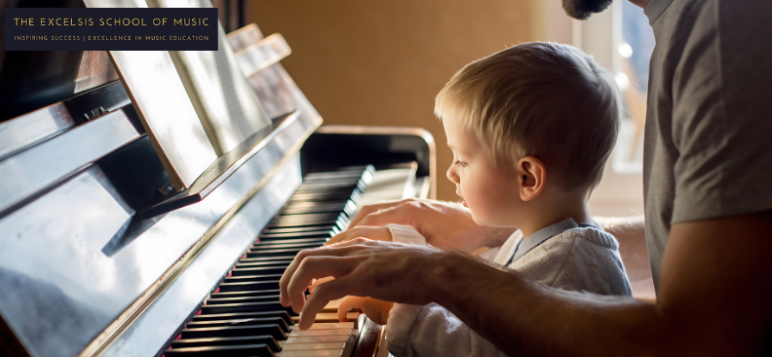
Enrolling your child in piano lessons is one of the most effective ways to support cognitive development, academic progress, emotional wellbeing, and creative expression. Music education—particularly structured piano training—stimulates multiple areas of the brain simultaneously, strengthening memory, concentration, coordination, and problem-solving skills.
At The Excelsis School of Music, our piano lessons in London are designed to nurture technical skill, musical understanding, and long-term confidence. Below are the top 10 evidence-based benefits of enrolling your child in piano lessons.
1. Increases Cognitive Development.
Intensifies the Neural Connections.
The learning of the piano involves reading music, playing both hands together, listening and understanding of rhythm at the same time. Research by Harvard University indicates that musical training enhances neural pathways and plasticity of the brain among children.
Piano playing uses both motor, auditory, and visual processing centres, and stimulates development of the whole brain at the same time.
Enhances Problem solving Skills.
The children learn to identify the characteristics of a pattern, correct mistakes and to use a systematic reasoning when they practise scales, chords and musical passages. This develops analytical and logical thinking that can be used in maths and science subjects.
Psychological advantages of piano classes:
• Improved memory retention
• Enhanced critical thinking
• More effective pattern recognition.
• Increased speed of information processing.
2. Improves Academic Achievement.
Favors Mathematics.
Music and mathematics are similar in terms of structure. Rhythm, beat counting, and time signatures as well as note values strengthen the understanding of numbers.
According to a study conducted by Stanford University, musical training enhances spatial-temporal reasoning, which is important in solving mathematical problems.
Enhances Literacy and Reading.
The reading of sheet music improves the decoding ability just like reading language. The American Psychological Association attributes better verbal memory and reading capacity among children to music education.
Academic advantages:
• Stronger numeracy skills
• Increased reading comprehension.
• Increased concentration at school.
• Increased test performance
3. produces Discipline and Patience.
Promotes Formal Practice.
The art of piano must be learned through practice. Children are taught that things can be improved through repetition and consistency.
The attainment of realistic practice objectives develops self-control and time management- which are critical to success in the long run in school and life.
Learns Deferral of gratification.
Practicing a difficult work is not an easy task. This is what will instill a sense of resilience and perseverance.
Character-building outcomes:
• Improved concentration
• Greater self-control
• Stronger work ethic
• Long-term goal setting
4. Enhances Recollection and Focus.
Enhances Working Memory
Students of the piano are required to memorize notes, dynamics, the position of the fingers and tempo marks all at the same time. This enhances the working memory.
Johns Hopkins University research suggests that music training can be rather effective in enhancing auditory memory and control of attention.
Builds Sustained Attention
Playing the piano requires full concentration. Children eventually have increased attention spans.
Memory and focus benefits:
• Better recall abilities
• Improved listening skills
• Increased focus in learning.
• Better cognitive organisation.
5. Develops Self-confidence and Self-esteem.
Performance Experience
Structured performing opportunities are offered by recitals and examinations. Playing before a crowd does make one more confident.
Students in The Excelsis School of Music are made ready to ABRSM and Trinity examination which assist them to acquire recognised qualification and experience in public performance.
Sense of Achievement
Achievement of a work or an exam produces quantifiable achievement. Positive self-belief is strengthened by achievement.
Confidence-building effects:
• Less of performance anxiety.
• Increased self-expression
• Greater independence
• Increased presentation skills.
6. Improves Fine Motor Skills and Co-ordination.
Learns to use their hands and fingers.
Playing piano involves matching movement of hands with what one sees on sheet music. This enhances agility and coordination.
The fine motor control is especially developed in the early stages of development of young children.
Promotes Bi-lateral Brain Development.
The use of hands independently triggers brain hemisphere communication. Research pointed out by the Yale University indicates that musical training improves interhemispheric connectivity.
Motor development outcomes:
• Improved finger strength
• Better coordination
• Enhanced reaction time
• Greater physical control
7. Promotes Expression of Emotions.
Provides Creative Outlet
Music enables children to be safe and productive in expressing their emotions. Performing expressive music is one way of them getting to know about mood, tone and dynamics.
Expressive creativity helps in emotional intelligence and health.
Reduces Stress and Anxiety
Music possesses therapeutic characters. Research cited by the British psychological society suggests that music involvement is capable of decreasing the stress levels and aiding in regulation of emotions.
Emotional benefits:
• Improved mood
• Less emotional blindness.
• Healthy stress management
• Enhanced empathy
8. Develops Listening Skills
Enhances Auditory Discrimination.
Piano education enhances the skill of identifying the changes of pitch, tone, and rhythm. This improves the general processing of audiology.
Good listening skills enhance classroom participation and communicative skills.
Promotes Effective participation.
Students have to listen critically and detect errors to make changes.
Skills improvement in listening:
• Better speech recognition
• Improved communication
• Enhanced musical awareness
• Greater interaction in the classroom.
9. Develop Creativity and Imagination.
Promotes Musical Interpretation.
In addition to technical ability, piano lessons can train interpretation, learning about phrasing, dynamics, and style.
Music enhances creative thinking that is transferred to writing, art and creative solutions to problems.
Presents Composition Skills.
Children can play with the creation of the simplest melodies. This fosters creativity and innovation.
Creative development advantages:
• Stronger imagination
• Flexible thinking
• Innovative expression
• Artistic confidence
10. Offers Long-term Life Skills.
Promotes Lifelong Learning
Music is an art which one can enjoy in any given age. An initial training in piano provides a basis of a lifetime activity.
Develops Social and Cultural awareness.
Studying classical and modern compositions helps children to be exposed to various musical cultures.
In The Excelsis School of Music in London, the structured lessons of piano include technical training, music theory, performance preparation, and individualised instruction to provide a constant progress.
Long-term advantages:
• All-time appreciation of music.
• Better educational background.
• Enhanced adaptability
• Improved resilience
Opening your child to music in a piano course is much more than just music talent. It enhances the cognitive development, academic performance, discipline, emotional intelligence, creativity, concentration, coordination, self-confidence, memory, executive functioning, problem-solving skills, fine motor development, and personal growth generally.
Organized piano lessons do not only prepare children to take music testings and performances but also they are given skills that will help them in achieving success in all aspects of life.