
You’ve decided to start your child on an instrument. Private lessons, probably — because that’s what feels serious, what feels like real teaching. One teacher, one child, full attention. Makes sense.
Six months in, the child is restless, something’s not clicking, and you’re wondering whether you chose the wrong instrument or the wrong approach.
The private lesson assumption most parents make
Private tuition isn’t wrong. For some children at some stages it’s exactly right. But the assumption that one-to-one automatically means better — especially for younger children — misses something that experienced music teachers know and rarely say aloud: a lot of children between the ages of five and ten learn faster and stay engaged longer when they’re doing it alongside someone else.
The reason isn’t complicated. A child alone in a room with an adult, being corrected and redirected for forty-five minutes, is under a very specific kind of social pressure. Some children respond to it fine. Others spend the lesson trying to manage the adult’s attention rather than actually playing. They get self-conscious when they make a mistake in a way they wouldn’t in a group of peers, where everyone’s getting things wrong and nobody’s catastrophising about it.
Group piano lessons change that dynamic. Not by reducing the teaching — by changing the social conditions around it. The child who freezes under a teacher’s direct gaze will often play freely alongside two or three other children. The child who won’t attempt a new piece alone will have a go when a classmate does it first.
Why “group” doesn’t mean what most parents think
When parents hear “group class,” many picture a row of children taking turns while everyone else waits. That version exists. It’s not good. A class of twelve with one teacher is effectively a waiting room with occasional moments of attention, and anyone who’s watched a child drift off during a school music lesson knows what that looks like.
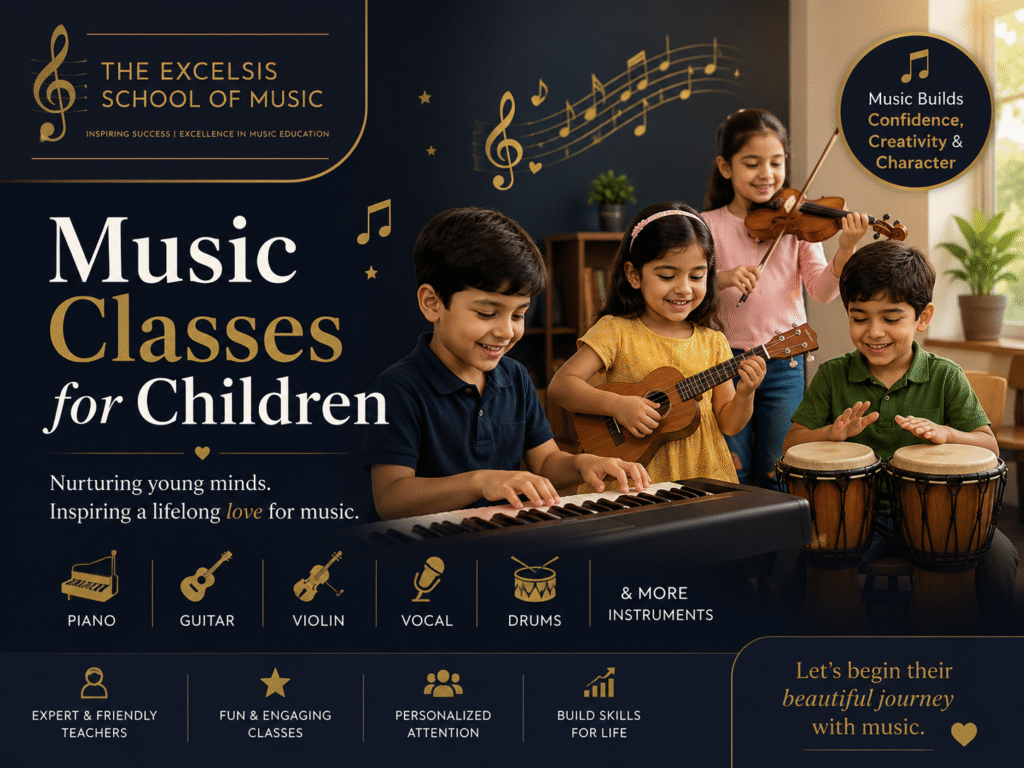
Small, properly structured music classes for children — four children at the outside, sometimes fewer — bear no resemblance to that. Each child still gets direct feedback. They play together, they play separately, and they listen to each other in a way that builds something private lessons don’t: the experience of making music with another person. That experience is what eventually makes a child comfortable playing in front of others. Exams, concerts, family Christmases. Children who’ve always been taught alone often find that first public performance unexpectedly difficult, not because they can’t play, but because they’ve never learned to keep going when someone else is in the room.
What happens when pace doesn’t match
The honest concern about group learning is pace. A child who picks things up quickly will mark time. A child who needs more room will feel the group pulling ahead. Both happen.
Good teachers handle this through repertoire and in-session structure rather than by adjusting the group’s overall speed. The child who’s ahead gets a more demanding version of the same piece, or an accompanying part. The child who needs more time gets a slightly simplified arrangement while working on the same musical concept. Same lesson, different entry point.
At Excelsis, the children’s programmes are grouped by age and ability together — not age alone. A seven-year-old two years into lessons doesn’t go in with a seven-year-old who started last month. Keeping those separate means smaller, more coherent groups, which takes more organising on the school’s side but produces a better experience for the child.
The confidence question nobody answers honestly
Parents worry their child won’t shine in a group. That the teacher won’t notice how well they’re doing, or that a more confident child will dominate the room.
Shy children often do better in groups than parents expect. The child who would never volunteer to play alone in front of a teacher will quite naturally have a go when a classmate does it first. Confidence in music isn’t built through solo performance under adult scrutiny — it builds through repeated, low-stakes experience of playing and being heard. Groups give children that experience every week, without it feeling like a test.
By the time an Excelsis student reaches an ABRSM exam or a school concert, performing in front of someone isn’t new. They’ve been doing a version of it all term.
What parents need to do at home
One thing group learning does shift is the home practice dynamic. In a private lesson, the teacher gives very granular individual feedback — this finger, this timing, this bar. In a group session, some of that specificity moves into the practice notes instead. Parents need to be a bit more present between sessions, not teaching, just prompting. “Show me what you learned.” “Play me the new piece.”
Most parents who engage with it end up glad they did. Watching what your child is actually working on — not just dropping them off and collecting them — changes how you understand their progress, and theirs. Excelsis builds in that involvement through regular updates and through its student concerts and events, where children perform what they’ve been building, term by term, in front of the people who matter to them.
Why location matters for this kind of commitment
Missed sessions are how progress disappears. A school forty minutes away in term-time North London traffic doesn’t get attended reliably. One within a straightforward distance does.
The Excelsis School of Music is in Southgate, N14 — on the Piccadilly line, accessible from Arnos Grove, Palmers Green, Winchmore Hill, Barnet, and Enfield without the central London journey. For families who need morning Saturday slots or early weekday evenings, that geography is one less thing working against you.
A free trial class is the easiest way to see whether your child responds to the group format or whether individual tuition suits them better. Most parents know within the first session.
The Excelsis School of Music Southgate, North London N14 020 8115 0413 Contact Excelsis