
You’ve probably been thinking about this longer than you’d admit. Something about sitting at a piano keeps nagging — the weight of the keys, the idea of actually making music instead of just listening to it. But every time you look into lessons, the same doubts come up. Private tuition feels expensive and oddly exposing. The thought of sitting alone with a teacher while every mistake echoes around a quiet room is enough to put most people off indefinitely.
Group piano lessons appeal for reasons that are hard to pin down at first. Cost is part of it. Not being the only beginner in the room is part of it. But the real reason — the one most adults don’t say out loud — is that learning alongside other people changes how you feel about getting things wrong. Nobody’s watching you specifically. Everyone’s working through the same awkward fingering, the same bar that refuses to come out right. That shared struggle is surprisingly freeing.
What most competing pages don’t bother addressing is that the format only works if it’s run properly. A badly structured group lesson is genuinely worse than practising alone. Five students at different stages, one teacher bouncing between them, everyone waiting for their two minutes of attention. That’s not teaching. Done properly, though, group piano instruction builds musical instinct faster than many people expect — because you spend the lesson listening as much as playing, and that listening does more work than most beginners realise.
What actually goes on in the room?
Most people picture a single teacher walking between pianos, nudging hand positions, moving on. The reality of a well-run class is quite different.
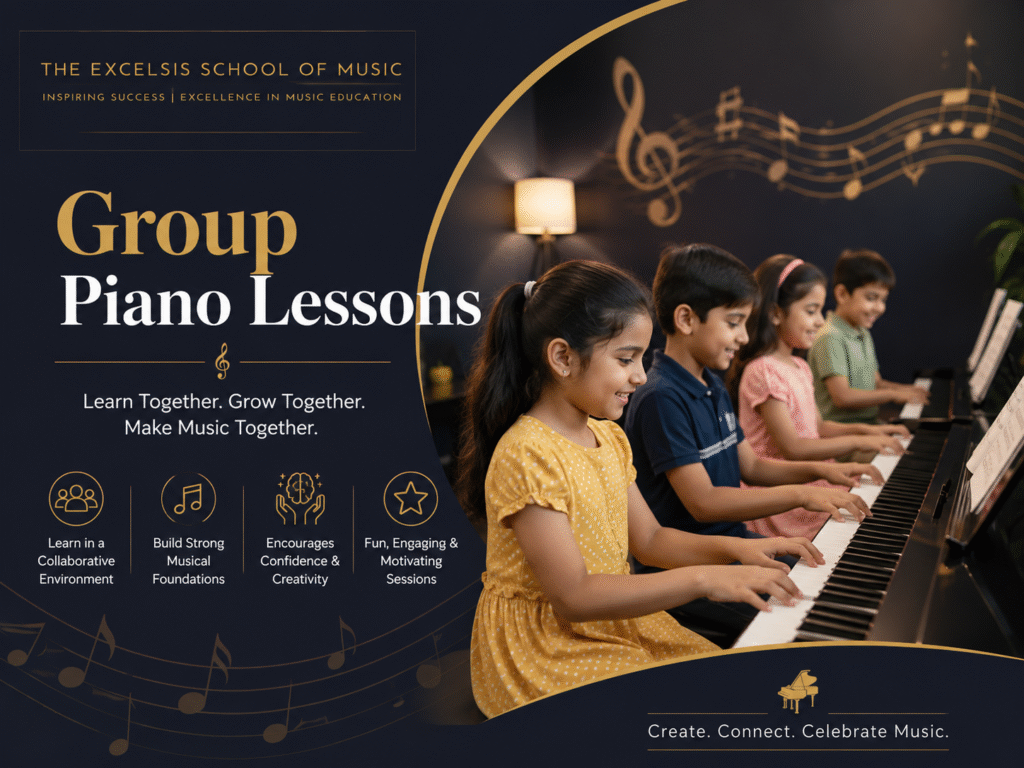
At Excelsis School of Music in Southgate, North London, lessons are built around active listening alongside playing. Students hear how other people handle the same phrase, notice what changes between one interpretation and the next, and gradually start developing an ear rather than just a technique. Private lessons rarely produce this naturally — you hear yourself and you hear the teacher, nothing else. In a group, you’re listening to music played by people at roughly the same level, and that gives you something to measure against.
For children, this dynamic matters in a very practical way. Kids who learn alongside other children tend to practise more between lessons — not because anyone’s forcing them, but because there’s a quiet accountability in showing up the following week having not bothered. It’s not competitive. It’s more like being part of a small team where everyone’s working on the same project.
The people group lessons are actually designed for.
There’s a particular type of person who finds the usual framing of piano lessons fairly alienating. They played as children. Got to Grade 3, maybe Grade 4, and then school got intense, or university happened, or work and family took over. Now, years later, they want to go back to it — but they’re stuck between categories. Not a beginner exactly. Nowhere near intermediate. Sitting in an awkward gap with no obvious entry point.
Piano classes for adults at Excelsis are built around exactly this situation. The adult programmes account for what returning learners actually bring — real focus, a clearer sense of what they want from the music, patience that most teenagers don’t have — while also being honest about where the technical gaps usually sit. Nobody pretends otherwise. You work through what needs working through, at a pace that fits around a full-time life.
Adults learning in small groups also tend to find that the social anxiety they expected never quite materialises. A few weeks in, the weekly lesson stops feeling like an obligation and starts feeling like the one fixed point in the week that’s just for them. The people they’re learning with start to feel familiar. Music has a habit of doing that.
When group lessons make sense — and when they don’t.
For anyone starting from scratch, whether adult or child, group tuition is usually the better entry point. The structure is already there. The pace is set by the teacher rather than by the student’s knowledge of what they should be learning. Foundations get covered properly — posture, hand position, reading notation, basic theory — and the group format means those fundamentals get reinforced through repetition and observation rather than just being explained once and moved past.
For more advanced work — Grade 8 preparation, conservatoire entry, a specific repertoire — private lessons become more important. But group and individual tuition aren’t in competition with each other. A fair number of Excelsis students do both: group work for the ear training and peer context, one-to-one lessons for the technical detail that needs individual attention.
As for when to start — most people already know the answer to that. If the thought keeps coming back after you’ve pushed it aside, that’s probably the signal. There’s no required standard to meet before signing up. The most common thing adult learners say, looking back, is that they wish they’d started two years earlier instead of waiting for the right moment that never quite arrived.
Getting to Southgate from North London and beyond
Excelsis School of Music is in Southgate, N14. Students come from Palmers Green, Winchmore Hill, Enfield, New Barnet, Friern Barnet, Arnos Grove, and further out. Southgate station sits on the Piccadilly line, so getting there from central London is straightforward enough.
For families with younger children, distance is more of a factor than it might seem. A lesson that involves a forty-minute round trip becomes logistically heavy after a few months, and logistically heavy things tend to get quietly dropped. Being reasonably close to Southgate means the weekly routine stays manageable — and manageable routines are the ones children actually stick to.
Adults coming from work can often reach Southgate directly from their office. Evening slots exist specifically for this. The school doesn’t assume everyone has spare afternoons.
What the school does that others don’t
Excelsis runs annual student concerts — actual performances, not in-house showings. Children from group piano classes share the same stage as adult learners. This is built into the school calendar, not treated as an optional extra. It matters because performance is where everything you’ve been practising becomes real. A lot of music schools mention performance opportunities; not many make them a regular, expected part of the year for every student.
The teaching staff are qualified, DBS-checked, and work across the full range of ages and ability levels. The school also covers the wider musical picture — theory, musicianship, and ensemble work — because piano in isolation, without any of that surrounding context, tends to produce students who can play the notes but don’t really connect with the music. That’s a specific and very fixable problem, and the way you fix it is by treating music as a whole thing from the beginning.
To find out about current group piano lesson availability or to book a trial, get in touch directly through the Excelsis contact page. A trial lesson is exactly that — a chance to see how the school works before committing to anything.
Excelsis School of Music
Southgate, North London, N14
Tel: 020 8115 0413
www.excelsismusic.co.uk