
Ask ten piano teachers what age a child should start piano lessons for kids, and you’ll likely get ten slightly different answers. That’s not because nobody knows what they’re talking about, it’s because there genuinely isn’t one correct starting age. Readiness has far more to do with a child’s attention span, curiosity, and physical development than with the number of birthdays they’ve had.
That said, there are useful patterns worth knowing if you’re trying to work out whether now is the right time for your child.
Why There’s No Single “Correct” Starting Age
Two children can be the same age and be at completely different starting points. One five-year-old might sit happily through a fifteen-minute activity, follow instructions, and show real curiosity about the piano, while another might still be working out how to sit still for that long. Neither is unusual, and neither means anything about future musical ability.
Rather than fixating on an age, it’s more useful to look at readiness signs, which tend to matter far more than the calendar.
Signs Your Child May Be Ready
A few practical indicators tend to predict how well a child will settle into piano lessons, regardless of their exact age:
- Attention span. Can they focus on a single activity, even a simple one, for ten to fifteen minutes without needing constant redirection?
- Curiosity about sound and music. Do they hum, tap out rhythms, or show interest when music is playing, even informally at home?
- Finger strength and coordination. Can they manage basic fine motor tasks, like turning pages, holding a pencil, or doing up buttons? Piano playing draws on similar coordination.
- Willingness to follow instructions from someone other than a parent. This matters more than people expect, a child who struggles with any adult-led instruction may need a little more time before formal lessons click.
- Genuine interest, rather than parental enthusiasm alone. Lessons tend to go far better when the interest is at least partly the child’s own, even if a parent is the one who first suggested it.
If most of these sound like your child, they’re probably ready, whatever their exact age happens to be.

What Lessons Look Like for Ages 4–6, 7–11, and Teens
Ages 4 to 6. Lessons at this age are short, playful, and built around games, rhythm, and simple listening exercises as much as actual note-reading. The goal isn’t rapid technical progress, it’s building a positive, low-pressure association with the instrument and the process of learning. Sessions are often shorter than for older children, since attention spans are naturally more limited.
Ages 7 to 11. This tends to be the sweet spot for more structured progress. Children in this age band typically have the attention span, coordination, and reading ability to move through the fundamentals properly, hand position, reading the stave, basic rhythm, and simple two-hand coordination. Many students in this range begin working towards their first formal exam grade if that’s something the family wants to pursue.
Teens. Lessons for teenagers look quite different again. There’s usually more focus on musical taste and preference, alongside more advanced technical work for those continuing towards higher grades. Teenagers respond well to teachers who treat them as capable of real musical judgement, rather than simply following instructions, and who can hold their attention without talking down to them.
| Age Band | Lesson Focus | Typical Session Style |
|---|---|---|
| 4 to 6 | Games, rhythm, simple listening, positive first association | Short, playful sessions |
| 7 to 11 | Hand position, reading the stave, two-hand coordination, first exam grades | Structured, steady progress |
| Teens | Musical taste, advanced technique, higher grades | Treated as capable near-adults |
What If Your Child Is Starting “Late” as a Young Teen?
Parents sometimes worry that starting at 12, 13, or 14 means their child has “missed the window.” In practice, this isn’t true. Teenagers who start piano for the first time often progress faster than younger beginners in some respects, because they have better focus, stronger reading skills, and can understand instructions more abstractly rather than needing everything demonstrated repeatedly.
The main adjustment is in how lessons are framed. A teenager starting from scratch generally wants to feel like they’re being taught as a capable near-adult, not given the same material as a six-year-old. A good teacher adjusts repertoire and pacing accordingly, so a teen beginner never feels like they’re working through “kids’ books.”
How Excelsis Music Adapts Its Programme by Age Group
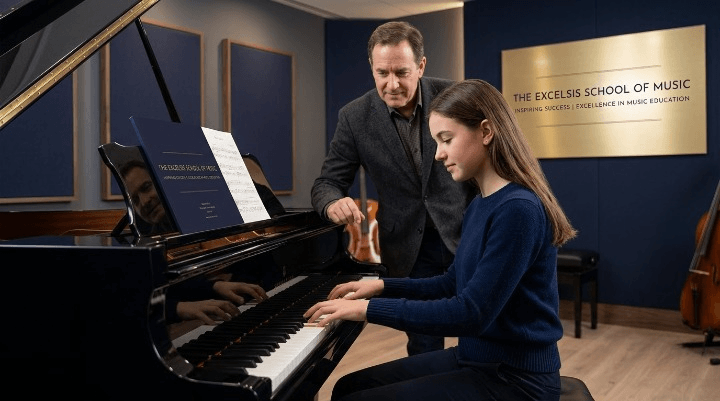
At Excelsis, children are grouped by age and stage from the outset, rather than placed into a single one-size-fits-all beginner track. Our youngest learners, ages 0 to 3, start in musicianship classes built entirely around movement, rhythm, and listening, with no instrument required and a parent or carer taking part alongside them. This is less about producing a musician early and more about laying the groundwork that makes formal instrument learning click faster later on.
From around age 4, children move into structured instrumental lessons in piano, violin, or guitar, taught individually or in small groups, with real progression built in. By age 7 or 8, most students are reading music and, for those who want it, working through their first exam grades. Our approach throughout is built on Kodály and Dalcroze principles, prioritising listening and genuine musical understanding before formal notation, which tends to make the transition into reading music feel far less abrupt.
For teens, lessons shift towards more structured technical work, optional exam pathways, and ensemble opportunities, with teachers experienced at engaging older students who expect to be taken seriously. If you’d like the fuller picture of how our programmes are structured across every age group, our music classes for children page covers the full journey from babies through to teenagers.
Book an Age-Appropriate Trial Lesson
Trial lessons at Excelsis are free, age-appropriate from the outset, and come with no pressure or long commitment attached.
Book a Trial Lesson