There’s no single correct age to start piano lessons for kids, whatever the parenting forums might have you believe. Some children are ready to sit at a keyboard and follow instructions at four. Others aren’t interested until they’re seven, and a few don’t pick up an instrument until they’re teenagers and take to it faster than anyone expected. What actually matters isn’t a birthday, it’s readiness — and readiness looks different in every child.
That doesn’t mean age is irrelevant. It shapes what a first piano lesson should actually look like. A four-year-old and an eleven-year-old need very different things from a teacher, even if they’re both complete beginners. Here’s how to think about timing, what to watch for, and how lessons change as your child grows.
Why There’s No Single “Correct” Starting Age
Ask five music teachers when a child should start piano and you’ll get five different answers, because the honest one is “it depends.” Some children have the fine motor control and concentration for structured lessons at four. Others are still working that out at six or seven, and pushing them into formal lessons too early can do more harm than good — a bored, frustrated five-year-old at the piano is a good way to end up with a child who decides music “isn’t for them” before they’ve really given it a chance.
Musical exposure, on the other hand, can start much earlier. Even without touching a keyboard, babies and toddlers who are sung to, clap along to rhythms, and move to music are quietly building the listening skills that make formal instrument lessons click later on. So the real question isn’t “when should my child start piano,” so much as “when should my child start structured piano lessons” — and that’s a much more individual answer.
Signs Your Child May Be Ready
A few practical signs tend to matter more than age on a calendar:
- Attention span. Can they focus on one activity, even a simple one, for ten to fifteen minutes without needing to move on?
- Curiosity. Do they gravitate towards a keyboard or piano when they see one, ask questions about music, or hum along to songs?
- Finger strength and coordination. Can they hold a pencil with reasonable control, or manage buttons and zips? Piano needs a degree of fine motor development that varies a lot between five and seven-year-olds.
- Willingness to be corrected. Lessons involve gentle correction — “try that again” — and a child who melts down at every small mistake usually isn’t quite ready for formal tuition yet, even if they love music.
None of these need to be perfect. A child who’s a bit wobbly on attention but genuinely curious will often do better than one who can sit still but couldn’t care less about the piano.
What Lessons Look Like for Ages 4–6, 7–11 and Teens
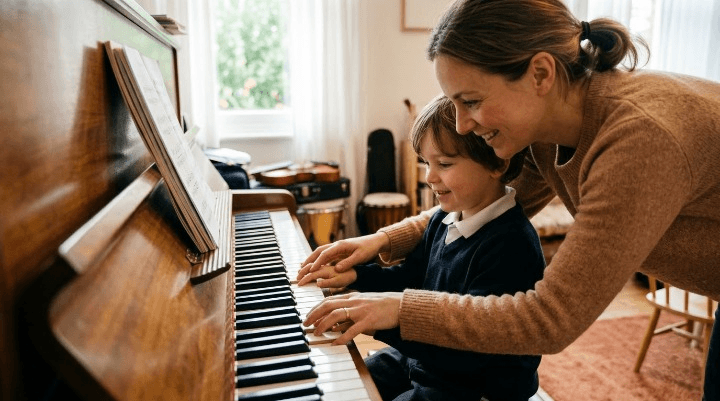
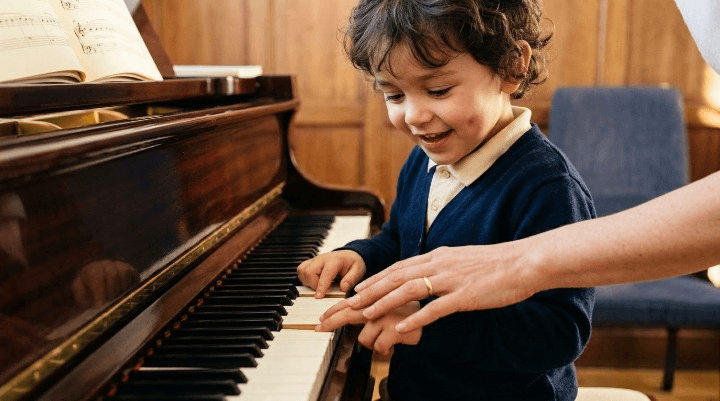
Ages 4–6. Lessons at this age barely resemble what most adults picture as a piano lesson. There’s a lot of rhythm, singing and movement before there’s any serious reading of notation. Sessions are shorter, playful, and often taught in small groups, because young children learn through play and through watching each other far more than through solo drilling.
Ages 7–11. This is where most children start reading music properly and working towards a recognisable sense of progression — first pieces, first small performances, sometimes a first exam grade. Attention spans are longer, and children this age often respond well to a bit of friendly competition or working towards something concrete, like a concert.
Teens. Teenagers who start piano for the first time learn differently again. They understand cause and effect, they can practise with real independence, and they often move through the early stages faster than younger children because they grasp abstract concepts like key signatures and time signatures more quickly. What they need most is a teacher who treats them like a capable near-adult, not a bigger version of a seven-year-old.
Here’s how the three stages compare at a glance:
| Age Group | Lesson Style | Typical Focus | Reading Music |
|---|---|---|---|
| Ages 4–6 | Short, playful, often small-group | Rhythm, singing, movement | Introduced gradually |
| Ages 7–11 | Structured, individual or small-group | Technique, first pieces, first grades | Reading confidently |
| Teens | Independent, faster-paced | Repertoire matched to their interests | Grasps notation quickly |
What If Your Child Is Starting “Late” as a Young Teen?
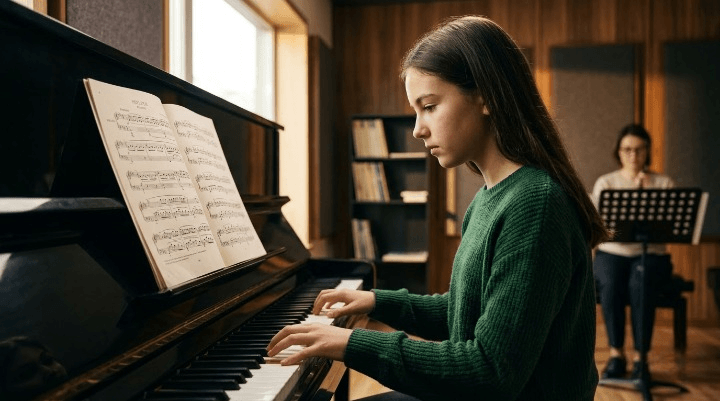
Thirteen or fourteen is not late. It only feels that way next to the odd child who’s been playing since they were five. Teenagers who start piano from scratch tend to move through beginner material quickly, precisely because the skills that make early lessons slow for young children — reading, counting, understanding structure — are already in place. What genuinely matters for a teenage beginner is a teacher who won’t hand them material written for seven-year-olds and expect them to feel motivated by it. The music has to match the person, not just the skill level.
How Excelsis Music Adapts Its Programme by Age Group
At Excelsis Music in Southgate, North London, our programmes are built around exactly this — children develop at different rates, and lessons should reflect that rather than fight it. Our Young Musicians programme (age 4–11) uses Kodály and Dalcroze principles, so younger beginners learn through movement, singing and listening before they’re expected to read a note off the page. By around seven or eight, most students are reading music confidently and working through their first grades.
Our Tweens & Teens programme (age 12–17) is built separately, with material and pacing suited to older beginners and more experienced players alike, including group piano lessons for those who enjoy learning alongside others their own age. All our teachers are DBS-checked and experienced across the full age range, from toddlers through to teenagers starting from scratch.
One of our longstanding parents put it simply: her boys started with us at three years old and were reading music and playing simple pieces before they could read and write. That’s not unusual for children who start early with a playful, movement-based approach — but it’s not the only route to a confident young pianist either.
Book an Age-Appropriate Trial Lesson
The easiest way to work out whether your child is ready, and which approach suits them best, is a trial lesson. We’ll match your child with a teacher and a starting point that fits their age, personality and attention span, whether that’s a group class for a curious four-year-old or one-to-one lessons for a fourteen-year-old starting from scratch. Get in touch to book a trial and find the right starting point for your child, or take a look at our full music classes for children to see what’s available across every age group.
Book a Trial Lesson