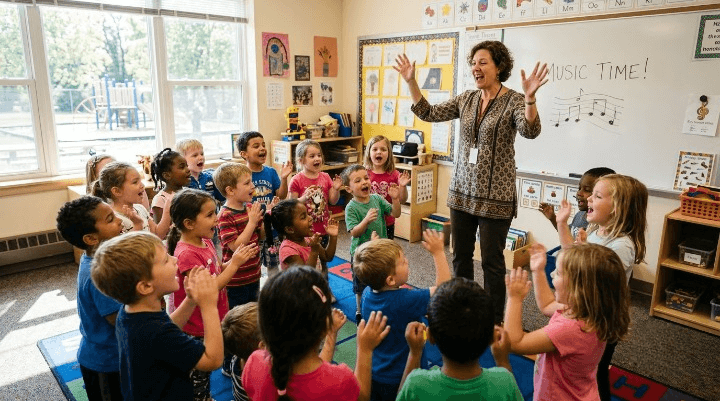
Kodály-based music teaching starts with the voice, not an instrument. Children sing folk songs, clap rhythms and play listening games for months before notation is introduced, building an internal sense of pitch and timing that everything else is built on top of.
Named after the Hungarian composer Zoltán Kodály, the approach is built on a simple belief: you shouldn’t be asked to read a musical language you can’t yet speak. In practice, that reshapes almost everything about how a first year of lessons looks compared to a more traditional, notation-first start.
Singing Comes Before Everything Else
Every Kodály lesson leans heavily on singing, usually folk songs chosen because their simple, repetitive structure makes it easy to isolate one musical idea at a time. A class might spend several weeks singing the same handful of songs, gradually noticing patterns in rhythm and pitch without being told what those patterns are called yet.
This isn’t filler before the “real” lessons start. Singing trains the ear to recognise intervals and rhythm physically, through the voice, before a child is asked to translate any of it into symbols on a page. Children who’ve sung a rhythm dozens of times find it far easier to read that same rhythm later, because they already know what it’s supposed to sound like.
Rhythm and Solfège Games
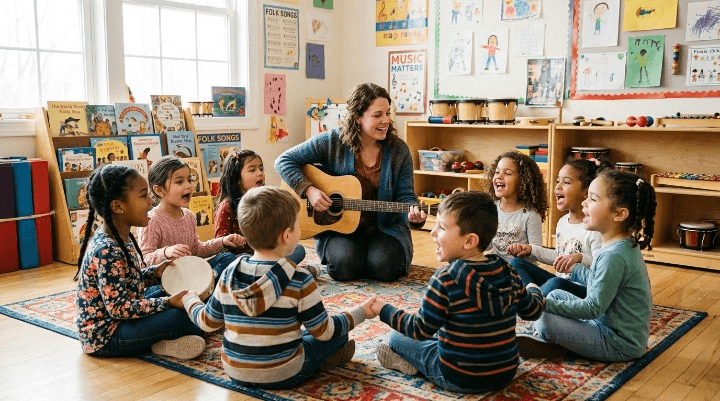
Alongside singing, Kodály classes use rhythm games, clapping, stepping, simple percussion, to build a physical feel for timing before it’s ever written down. Solfège syllables, do re mi fa sol la ti, are introduced early too, giving children a spoken shorthand for pitch relationships that works independently of any one instrument or key.
These games look playful, and they are, but they’re doing real work. A child who can clap a rhythm accurately and sing it back on solfège syllables has already done the hard part of reading music. Notation, when it finally arrives, is mostly just learning to write down something they can already do.
| Stage | What It Looks Like | Why It Matters |
|---|---|---|
| Singing and listening | Folk songs, echo games, group singing | Trains the ear before any symbol is introduced |
| Rhythm work | Clapping, stepping, simple percussion | Builds a physical feel for timing and pulse |
| Solfège | Do re mi fa sol la ti sung to known songs | Gives pitch a spoken, portable shorthand |
| Notation | Introduced once singing and rhythm are secure | Becomes a matter of writing down what’s already understood |
| Instrument playing | Follows once reading is comfortable | Playing and reading develop together rather than reading lagging behind |
Why It Suits Group Classes So Well
Kodály-based teaching was designed with classrooms in mind, not one-to-one tuition, and it shows. Singing games and rhythm work are naturally group activities, and moving a whole class through the same sequence of songs keeps everyone progressing together rather than racing ahead or falling behind individually.
That’s part of why the approach fits so naturally into our own group piano lessons, where singing and listening are woven in from the very first term rather than treated as a warm-up before the “proper” piano work begins. Children grouped by starting point move through the same songs and games together, which keeps a class genuinely cohesive rather than pulled in different directions.

What This Means for Parents
If your child is a few weeks into lessons and hasn’t touched sheet music yet, that’s not a delay, it’s the method working as intended. Ask your teacher what the singing and rhythm games are building towards, and you’ll usually get a specific answer about which musical concept is being laid down before notation arrives.
You can see how our own teachers structure this progression, and their backgrounds and training, on our our team page, and the full range of age groups this approach is used across on our programmes page.
See Kodály-Based Music Teaching in Action
Come along to a trial class and hear how singing, rhythm and listening games build the foundations before a single note is written down.
Book a Trial Class