If you’re researching music classes for children in London, you’ve probably already worked out that “just find a piano teacher” isn’t really enough of a plan. There’s a lot to weigh up: what age to start, what a proper school actually looks like compared with a private tutor working from a spare room, how exams fit in, and whether group lessons or one-to-one is the better call for your child specifically.
This guide pulls all of that together in one place, based on how we run things at Excelsis Music, a London music school in Southgate, North London, that’s been teaching children for over 20 years.
Why Music Lessons Benefit Children Beyond “Learning an Instrument”
It’s easy to think of music lessons as a single, standalone skill, alongside swimming or football. In practice, the benefits spread a lot wider than the instrument itself.
Cognitive development. Children who take structured music lessons tend to show stronger memory, concentration, and problem-solving skills than peers who don’t. Reading music and coordinating movement at the same time builds neural connections that carry over into reading, maths, and language, particularly when lessons start early.
Emotional and social growth. Group classes teach cooperation, listening, and turn-taking in a way that’s hard to replicate in other activities. Performing, even in small, low-key student concerts, builds a kind of stage confidence that tends to follow children into other parts of their life, from school presentations to simply being comfortable speaking up in a group.
Discipline and resilience. Learning an instrument teaches children something quite specific: that improvement comes from consistent effort rather than talent alone. That lesson, once it lands, tends to show up in study habits and general persistence well beyond the music room.
A relationship with music that lasts. The real marker of success isn’t just exam grades, it’s whether a child still wants to play five, ten, or twenty years later. Some of our current teenage students started with us as toddlers, which doesn’t happen unless the early experience was genuinely enjoyable rather than just tolerated.

What Age to Start, and What to Expect at Each Age Band
One of the most common questions we get from parents is simply: is my child old enough? The honest answer is that there isn’t a single correct starting age, readiness matters more than a birthday.
Babies and toddlers (age 0 to 3). At this stage, classes are built around movement, rhythm, and listening, with no instrument involved and a parent or carer taking part alongside their child. This is less about producing a musician early and more about building a natural, unforced relationship with sound and rhythm that makes formal learning easier later.
Young musicians (age 4 to 11). This is when most children start formal instrument lessons, in piano, violin, or guitar, taught individually or in small groups. By around age 7 or 8, most students are reading music and working through their first exam grades if they choose to.
Tweens and teens (age 12 to 17). Lessons at this stage tend to be more structured, often with an ABRSM or Trinity exam pathway, ensemble opportunities, and teachers who know how to hold a teenager’s attention, which is genuinely its own skill.
We go into this question in much more depth, including specific signs of readiness and what a first lesson looks like at each age, in our dedicated article on the right age to start piano lessons for kids.
What Separates a Proper Music School from an Ad-Hoc Tutor
Piano teachers advertised on local noticeboards or classified sites aren’t necessarily bad, but there’s a meaningful difference between an individual tutor working alone and an established music school with a track record.
A proper school typically offers a structured curriculum that’s been refined across hundreds of students, not just one teacher’s personal approach. It has cover arrangements if your regular teacher is ill, a wider community of other learners for your child to perform alongside, and a level of accountability that comes from being a registered business rather than an informal arrangement.
At Excelsis, our approach is built on Kodály and Dalcroze principles, two well-established methods that prioritise listening, movement, and genuine musical understanding before formal notation. The result tends to be children who understand what they’re playing, rather than children who can copy fingering patterns off a page without much sense of why. You can read more about our full teaching philosophy and the team behind it on our about us page.
Teacher Qualifications, Class Structure, and Safeguarding Basics Parents Should Ask About
Before enrolling a child anywhere, there are a few questions worth asking regardless of which school or tutor you’re considering:
- Is the teacher DBS-checked? This should be non-negotiable for anyone teaching children, whether in a group or one-to-one setting. Every teacher at Excelsis is formally qualified and DBS-checked.
- How are classes grouped? Ask whether children are placed by age, ability, or both. A class with a wide spread of ability levels can leave some children bored and others overwhelmed.
- What happens if my child needs extra support or falls behind? A good school adapts within the lesson rather than simply moving on regardless.
- Is there a safeguarding policy, and who’s responsible for it? A school should be able to answer this clearly and immediately, not have to check.
- What’s the class size? Smaller groups mean every child still gets direct, individual feedback from the teacher rather than sitting at the back and getting lost.
These aren’t awkward questions to ask, a school confident in what it offers will answer them without hesitation.
The Grading and Exam Pathway, Explained Simply
For parents unfamiliar with the world of music exams, the grading system can seem more complicated than it actually is. In the UK, the two main exam boards work on a similar structure: children progress through numbered grades, typically starting at Grade 1, each one testing technical playing, sight-reading, aural skills, and general musicianship at an increasing level of difficulty.
Exams aren’t compulsory. Some families want the formal structure and sense of progress a grade pathway provides, while others prefer to focus purely on enjoyment and skip exams altogether, both are completely valid approaches. At Excelsis, we offer structured exam preparation from Grade 1 upwards for families who want it, alongside musicianship and aural training classes that complement individual lessons and are particularly useful when it comes to the listening and ensemble elements of an exam.
Group Classes vs. One-to-One for Children
This is one of the most common decisions parents face, and there isn’t a universally “correct” answer, it depends on your child and what you’re hoping they’ll get out of lessons.
| Factor | Group Lessons | One-to-One Lessons |
|---|---|---|
| Best for | Complete beginners, sociable children | Exam preparation, advanced technical work |
| Pressure level | Low, learning alongside peers | Higher, full individual attention throughout |
| Cost | Lower per session | Higher per session |
| Scheduling | Fixed weekly class slot | More flexible, rearranged as needed |
| Social element | High, builds confidence with peers | None |
Many families find that their child’s needs shift over time, starting in a group setting for the social, low-pressure introduction, then adding or moving to one-to-one lessons as they progress or start working towards exams. You can read more about how this works specifically for our group piano lessons, which are designed to give children real, individual feedback within a small, sociable class.
How Excelsis Music Supports Children from First Lesson to First Recital
The journey from a nervous first lesson to a confident young performer doesn’t happen by accident, it’s built into how classes are structured.
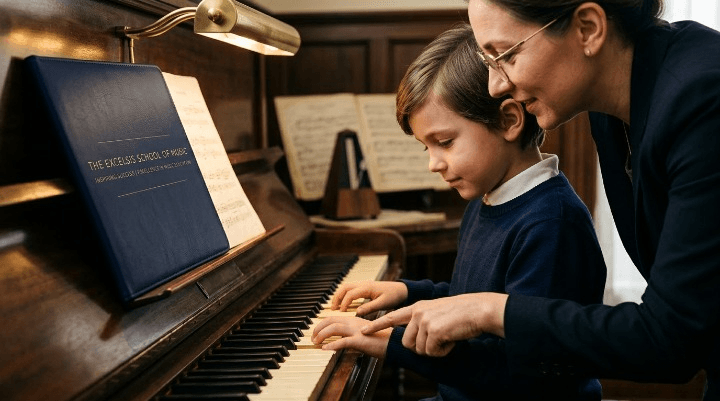
Children start in a class grouped by age and ability, so they’re never sitting alongside others who are miles ahead. Teachers build listening, movement, and musical understanding into lessons from day one, following Kodály and Dalcroze principles, rather than jumping straight to notation. As confidence grows, students who want to work towards graded exams are supported through structured preparation, while those who’d rather focus purely on enjoyment are just as welcome to do so.
Regular student concerts throughout the year give children low-pressure opportunities to perform in front of a supportive audience, well before any formal exam or big recital. These aren’t high-stakes events, they’re a chance to get used to playing for other people in an environment where mistakes are entirely normal. By the time a child reaches their first proper recital or exam, performing in front of others no longer feels unfamiliar.
Keeping a child motivated to actually practise between lessons is its own challenge, and one we cover in detail, along with practical strategies that work at home, in our article on why group piano lessons are great for beginners.
Frequently Asked Questions from Parents
What age can children start music classes?
Children can start from birth in musicianship classes built around rhythm, movement, and listening, with no instrument required. Formal instrument lessons, on piano, violin, or guitar, typically begin around age 4 to 5, depending on the child.
How much do children’s music lessons cost in London?
Group lessons are generally significantly more affordable than private one-to-one tuition, since the cost is spread across a small class rather than covering a teacher’s full attention alone. Fees vary by programme and age group, so it’s worth contacting a school directly for current pricing.
Which instrument should my child learn first?
Piano is often recommended as a starting instrument because it teaches melody, harmony, and rhythm simultaneously, giving children a strong general foundation. That said, if a child is genuinely excited about violin, guitar, or singing, starting with that instrument usually works better, enthusiasm matters more than logic at the beginning.
Are beginner classes really suitable for children with zero experience?
Yes. A properly run beginner class is made up entirely of children with no prior experience, grouped by age and level, so your child won’t be sitting alongside others who are already well ahead.
Do children have to work towards exams?
No. Exam preparation is available for families who want the formal structure of graded exams, but plenty of children learn purely for enjoyment without ever sitting a graded exam, and that’s an entirely valid path too.
Book Music Classes for Children Today
Trial lessons are free, with no obligation and no long commitment. See how your child responds before you decide.
Book a Free Trial