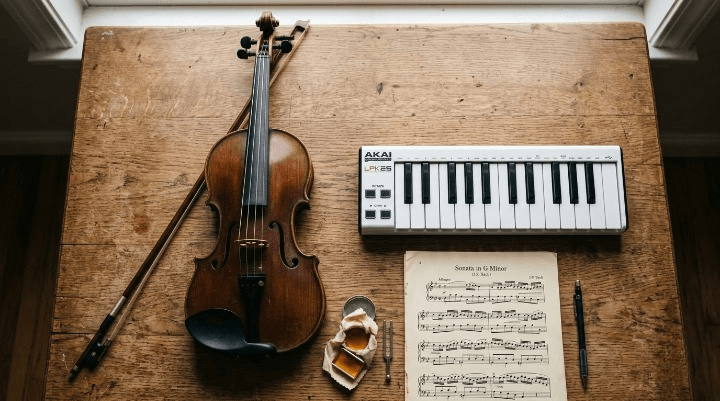
Violin vs piano: which is easier to learn first? Piano is generally the easier starting instrument, because it produces a correct, in-tune note the moment you press a key, while violin asks a beginner to create the right pitch themselves, with no frets or keys to guide them.
That single difference shapes almost everything about how the first few months feel on each instrument, and it’s worth understanding before deciding which one to start with, whether for yourself or for a child.
Why Piano Feels Easier at the Start
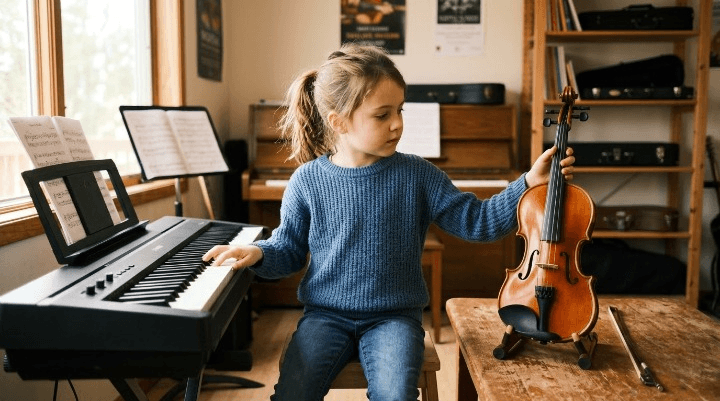
On piano, pitch is built into the instrument. Every key is already tuned, so a beginner’s job is simply to press the right one at the right time. That removes an entire layer of difficulty that violin students face from their very first lesson, and it’s why early progress on piano tends to feel faster and more encouraging.
Piano also makes music theory visible. Notes, intervals and chords sit laid out in front of you in a fixed, logical order, which makes reading music and understanding harmony considerably more intuitive than it is on an instrument where the same note can be played in several different positions.
Where Violin Has the Edge
Violin isn’t harder across the board, it’s differently demanding. Because pitch has to be found by ear and by hand position, violin builds a genuinely sharp sense of intonation far earlier than piano typically does. Students who stick with the early difficulty often develop a more refined ear as a direct result of the instrument being less forgiving.
Violin is also lighter and more portable than a piano, and some children simply respond better to an instrument they can hold and move with, rather than sitting at a fixed keyboard. Motivation driven by genuine interest in the instrument itself often outweighs whichever one is technically gentler to begin with.
| Factor | Piano | Violin |
|---|---|---|
| Getting a correct note | Immediate – press the key | Takes weeks to find pitch reliably |
| Reading music | Notes laid out visually and logically | Requires more ear training alongside reading |
| Early motivation | Quick wins, encouraging start | Slower start, rewarding once pitch clicks |
| Ear development | Builds gradually | Builds early and sharply |
| Portability | Fixed at home | Easy to carry and practise anywhere |
Which One Should You Actually Choose
If the goal is a gentle, encouraging introduction to music with visible early progress, piano is the more forgiving choice, and it’s why so many teachers, including ours, suggest it as a first instrument even for students who plan to move to strings or wind instruments later. Piano also builds theory knowledge that transfers directly to almost every other instrument.
If a child is genuinely drawn to violin specifically, that enthusiasm is worth taking seriously. A student who wants to play violin will usually push through the harder early stage more willingly than one who was steered towards piano purely because it’s statistically easier. Our group piano lessons remain a strong starting point for undecided beginners of any age, giving a solid musical foundation before committing to a second instrument.
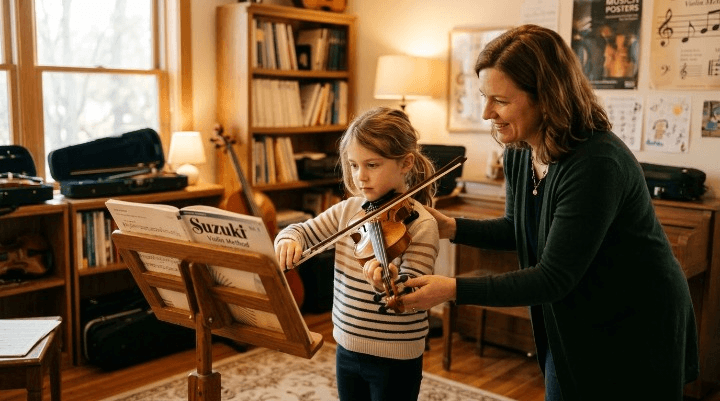
Whichever instrument you land on, the first few months matter more for building a practice habit than for virtuosity. Choose the one that will actually get picked up and practised, and the rest tends to follow.
Still Deciding Between Violin and Piano?
Come along to a taster session and try both before committing to lessons.
Book a Taster Session