
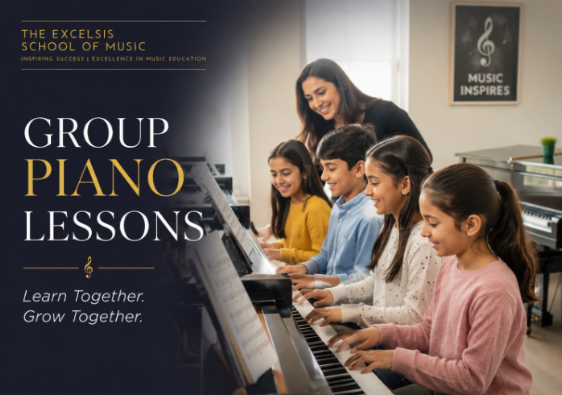
When parents call a music school for the first time, the question is almost always the same. How long before my child can play a real song? Understandable. But the question that actually determines whether this goes well — what kind of learner will this setting produce — rarely comes up until much later.
Private lessons and group piano lessons don’t just differ in cost or class size. They shape different musicians. For children who learn by watching, listening, and picking up on what others around them are doing, the group format does something a solo lesson doesn’t get close to.
The listening thing nobody talks about
One-to-one piano teaching runs a tight feedback loop. You play, the teacher responds. You try again, the teacher adjusts. It works. But it’s narrow.
Put five children in a room working through the same piece, and something else starts happening. One child notices another rushing the tempo. Someone else hears a classmate finally land a transition they’ve been fumbling on for weeks. That kind of listening — real-time, comparative, happening without instruction — builds musical ear differently than solo drilling does.
The Kodály method, which underpins how Excelsis Music teaches, treats listening as a trainable skill rather than background noise. Groups are where that training actually happens.
Performance anxiety — the thing that stops more children than poor technique
Music teachers see it constantly. A child who practises well at home, who knows the piece, who can play it through without errors — and then goes completely blank the moment someone else is in the room.
Performance anxiety is a more common ceiling than missing technique. And it gets harder to shift the longer it goes unaddressed.
Weekly group piano lessons at Excelsis in Southgate, North London solve this in a way most parents don’t expect. Playing alongside peers at roughly the same level — peers who are also making mistakes, also stumbling on the same bars — means being heard stops feeling like exposure. It becomes ordinary. Children who’ve played in front of their group every week for a year don’t panic at recitals. The nerves show up but they don’t take over.
That transfer matters well beyond music. A child who learns to perform under mild pressure at age seven carries that into school presentations, assemblies, sport — anywhere being watched is part of the deal.
Age groupings at Excelsis — how it actually breaks down
A four-year-old and a twelve-year-old learn piano in fundamentally different ways. Excelsis runs separate tracks rather than grouping students by rough age alone.
The Programmes page covers all of them: babies and toddlers, young beginners from around age four, tweens and teens, and adult beginners and returners. The teaching approach changes substantially across those groups — a four-year-old needs movement, song, and play before any formal notation enters the picture. A teenager working toward ABRSM grades needs something entirely different.
Adults get their own strand for good reason. Learning piano as a grown-up carries a particular reluctance — the assumption that the window has closed, that everyone else will be further along, that being a beginner at 38 is somehow embarrassing. That feeling mostly disappears when you’re in a room full of people who started last month too. Adults in group classes also turn up more reliably than those taking solo lessons. There’s a group expecting them, and that turns out to matter more than motivation alone.
Why the teaching method matters as much as the format
Schools describe their lessons as “fun” and “engaging” so routinely that both words have stopped meaning anything. What actually matters is the underlying method — the theory of how musical understanding develops — because that determines whether students genuinely learn music or whether they learn songs.
Excelsis teaches from Kodály and Dalcroze principles. In Dalcroze teaching, the body learns rhythm before the page does — students clap, step, and move through a dotted rhythm or syncopated beat until the body has it, then the notation follows. Kodály works through singing, ear training, and the relationships between notes rather than their positions on a stave.
Students who go through this tend to read music, understand what they’re playing, and pick up improvisation and transposition without being pushed. The method builds those things deliberately. A group is also where both approaches work best — eurhythmics with one student and one teacher doesn’t generate the shared energy the method depends on.
Questions worth asking before you enrol
Before committing to any group piano programme in London, a few things are worth finding out.
Ask about group size. Small means something different at every school. Excelsis keeps its groups tight. Four or five students is a learning environment. Twelve is a rehearsal where individual attention gets thin.
Ask about performance. A school that never puts students in front of an audience produces pianists who can only play alone. Excelsis holds regular concerts — the Events page has current dates — and performing is part of the curriculum rather than something tacked on at the end of term.
Ask what happens when a student’s level diverges from the group. Progress isn’t uniform. A school that’s thought about this should be able to answer without hesitation.
And spend some time on the Testimonials page. What parents describe, in their own words, about what changed for their children tells you more than any copy written by the school.
An honest word about who group lessons don’t suit
A student already at Grade 4, working toward specific examination targets, needs focused one-to-one attention. Someone aiming for conservatoire will eventually need private tuition. Group lessons aren’t a universal answer.
For most beginners, though — children and adults alike — the group setting builds something private lessons take much longer to develop. Showing up weekly because others are expecting you. Getting comfortable being heard while still imperfect. Realising that making mistakes in front of people is survivable, and then unremarkable.
Most people who stop playing cite nerves, not lack of skill. Getting heard regularly, while still imperfect, is what keeps that from happening.
Come and watch a session — book a trial at Excelsis and see a group class running.